Introduction
There’s a version of kitchen appliance shopping that goes badly for a lot of people. They buy something inexpensive, it underperforms, they tolerate it for longer than they should, and eventually they buy a better version of the same thing anyway — having spent money twice and lived with frustration in between. Blenders are one of the most common examples of this pattern. The price gap between a basic blender and a genuinely capable one feels significant at the point of purchase, but the experience gap between using them daily makes the initial savings feel considerably less worthwhile in hindsight.
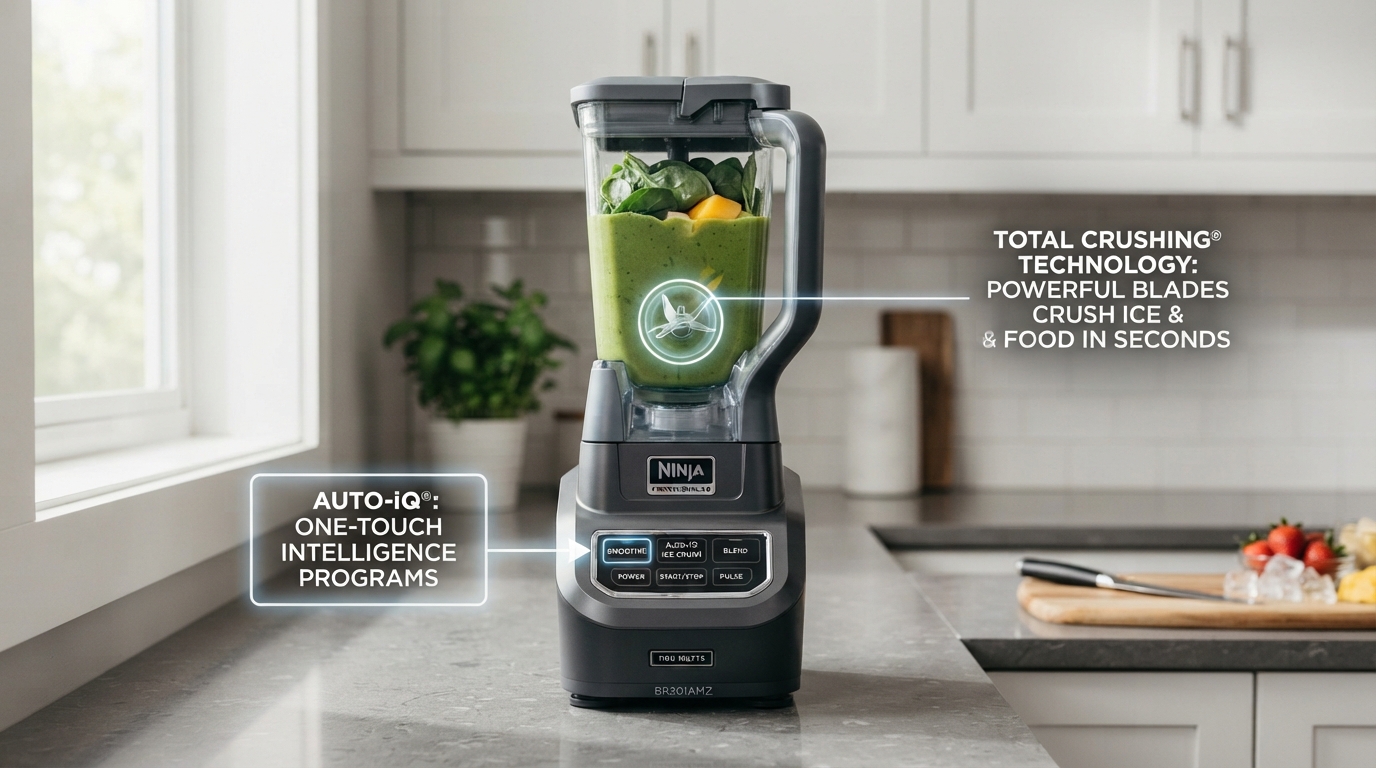
The Ninja Professional Blender 2.0 sits at a position designed to end that cycle — capable enough to handle what most households actually need from a blender on a daily basis, without the price tag of commercial-grade equipment that goes beyond what home cooking realistically requires. At 1,200 watts with a stacked blade system and Auto-iQ intelligent programs, it’s built around the tasks that matter most in everyday blending: smooth smoothies from frozen fruit, properly crushed ice, thoroughly processed fibrous ingredients, and consistent batch results for multiple people at once from the 72-ounce XL pitcher.
This is the fourth version of this article we’ve written, which means the approach here is deliberately different — not covering the same ground in the same order, but finding a fresh angle on a product that genuinely merits the thorough treatment regardless of how many times it’s been examined.
What the Ninja Professional Blender 2.0 Actually Is
The BR201AMZ sits in the middle tier of Ninja’s blender lineup — meaningfully above the personal and single-serve models, below the ultra-premium Foodi Cold & Hot blender range. The “2.0” designation reflects the addition of Auto-iQ to the manual speed controls that characterized earlier Professional Blender versions, creating a machine that serves both people who want automated blending programs and those who prefer manual control throughout the process.
The dark grey finish, 72-ounce BPA-free pitcher, and stacked blade assembly define its physical identity. The 1,200-watt motor and Total Crushing Technology define its performance identity. Together, they describe an appliance positioned for serious everyday household blending rather than either casual occasional use or professional-level operation.
Starting With the Motor: Why 1,200 Watts Changes the Experience
Most discussions of blender wattage treat the number as a straightforward more-is-better specification, which misses the more interesting question: what does a specific wattage level actually change about the daily blending experience?
The honest answer requires thinking about resistance. A blender motor spinning blades through liquid ingredients faces almost no resistance — even a 300-watt motor handles liquids without difficulty. The motor’s capability becomes relevant when the ingredients fight back. Frozen mango chunks at -18°C have significantly more structural integrity than room-temperature mango. A handful of raw almonds resists blade penetration in a way that soft fruit doesn’t. Kale stems are fibrous in a way that spinach leaves aren’t.
When a blender encounters resistance that exceeds its motor capacity, several things happen: blade speed drops, the motor runs hotter than ideal, the processing time extends to compensate for reduced efficiency, and the final texture reflects incomplete processing — some material fully broken down, other pieces remaining in larger chunks that create inconsistency in the finished product.
At 1,200 watts, the Professional Blender 2.0 doesn’t reach its limit with the challenging ingredients that everyday household blending realistically involves. Frozen fruit, whole ice cubes, raw nuts, fibrous greens — these are the ingredients that expose underpowered blenders. At 1,200 watts, they’re handled without the slowdown and inconsistency that 500 or 700-watt machines experience under comparable loads.
The practical translation of this is simple: the texture difference between what a capable machine produces and what an underpowered one manages is noticeable in every smoothie, every frozen drink, and every batch of blended soup. That difference compounds over daily use into a significantly better blending experience across months and years of ownership.
Total Crushing Technology: The Blade System Explained
Wattage matters, but wattage alone doesn’t determine blending quality. The blade system that the motor drives is equally important — and the stacked blade design in the Professional Blender 2.0 is worth understanding in detail because it’s directly responsible for the consistency of results the machine produces.
A conventional blender has blades at a single level — typically at the base of the pitcher. The physics of blending in this configuration require all ingredients to eventually migrate downward into the blade zone. A vortex forms that pulls material from the sides down toward the center and into the blades, which works effectively for liquid-rich blends where the vortex forms quickly and maintains itself throughout blending.
The problem emerges with denser combinations. When the pitcher contains significant frozen content or very thick mixtures, the vortex doesn’t form as easily. Material in the upper portion of the pitcher doesn’t get drawn down into the blade zone as readily. The result is uneven processing — the lower material is completely processed while the upper material remains in larger pieces, requiring the blending to be stopped, the pitcher removed, the contents stirred, and the blending restarted.
Total Crushing Technology addresses this through multiple blade tiers at different heights in the pitcher. Rather than creating a single processing zone at the base, the stacked design creates active processing at several heights simultaneously. The vortex still matters, but even material that doesn’t immediately get drawn to the base encounters blade contact at its current level in the pitcher. The effect is more thorough processing throughout the entire pitcher volume in less blending time, with more consistent particle size distribution in the finished product.
For everyday smoothies, this translates to more consistent texture — no gritty pockets where some material wasn’t fully processed, no large fragments of leafy greens surviving in the finished drink. For ice crushing, it means more even ice processing throughout the pitcher rather than fine ice near the base and larger chunks near the top. For grain grinding and nut processing, it means more consistent particle size across the batch.
Auto-iQ: Intelligent Programs That Replace Manual Technique
The Auto-iQ system is what most clearly separates the Professional Blender 2.0 from the earlier version it updates, and understanding what it actually does requires thinking about what manual blending technique involves.
An experienced blender user making a frozen fruit smoothie doesn’t just run the machine at maximum speed for a fixed time. They might start at a lower speed to begin incorporating the ingredients before the vortex is fully established. They increase speed as the vortex forms and starts pulling frozen fruit into the blades. They use pulse patterns to dislodge material that gets stuck against the sides. They run at maximum speed for a final smoothing pass. They stop at the moment the texture sounds and looks right.
This sequence isn’t arbitrary — it reflects how different ingredients behave during blending and how different phases of a blending cycle serve different processing purposes. Developing the intuition to manage this manually requires experience and attention throughout each blending session.
Auto-iQ removes the requirement for that experience and attention by coding the optimal sequence into preset programs. Select the smoothie program, press start, and the machine executes a predetermined pattern of speed increases, decreases, and pulse bursts calibrated through testing to produce optimal smoothie results from a standard base-and-fruit combination. The program runs for the calibrated duration and stops automatically.
The practical benefits are twofold. First, consistency — the same program executed the same way produces comparable results regardless of who’s operating the blender or what time of day it is. Second, freedom from attention — the machine manages the blending sequence, which means the person using it can move on to other breakfast preparation tasks rather than standing at the counter managing blend speed.
Auto-iQ programs don’t replace manual controls for every application. Chunky salsas, partially blended dips, and applications where specific texture control matters more than automated smoothness still benefit from manual pulse operation and direct speed management. The manual controls remain available for exactly these situations.
The 72-Ounce Pitcher: Understanding the Capacity Advantage
Seventy-two ounces is nine cups — a number that may seem abstract until it’s translated into real serving scenarios.
Consider a family of four each wanting a smoothie before school and work. A standard 48-ounce pitcher produces roughly three servings before requiring a second blending session. The 72-ounce pitcher produces those four servings in a single cycle. The time difference between one blending cycle and two isn’t dramatic — perhaps three minutes — but in a compressed morning routine where multiple simultaneous demands are competing for attention, the difference between finishing breakfast preparation in one cycle versus two is felt.
The same calculation applies to frozen cocktail making during entertaining. Margaritas for eight people from a 48-ounce pitcher requires two or three cycles. From a 72-ounce pitcher, the same quantity is possible in one or two cycles. For a host managing multiple hosting responsibilities simultaneously, fewer blender cycles means more time for other things.
Batch smoothie preparation for the week ahead benefits even more directly. Someone who batch-blends smoothie bases every Sunday, portioning into freezer containers for the week ahead, can process more quantity per cycle — fewer total blending sessions to achieve the same volume of finished product.
The pitcher’s BPA-free plastic construction balances weight, clarity, and durability in a way that glass alternatives at this capacity don’t — a 72-ounce glass pitcher full of smoothie would be both extremely heavy and vulnerable to the mechanical stress of high-speed blending vibration.
Practical Applications Across Different Household Types
The Health-Focused Daily Smoothie Household
For households where morning smoothies are non-negotiable daily nutrition — dense leafy greens, frozen fruit, seeds, nut butters, protein powder, and whatever else goes into a genuinely nutritious morning drink — the machine’s performance with challenging ingredients matters every single day. The difference between a smoothie where kale is completely processed and one where it leaves green fragments is the difference between a pleasant morning drink and an unpleasant one. The 1,200-watt motor and stacked blades ensure the former consistently.
The Weekend Hosting Household
For people who entertain regularly — dinner parties, game days, casual gatherings where blended cocktails or drinks appear — the 72-ounce capacity and ice crushing capability serve a specific hosting need. Being able to produce a full pitcher of frozen margaritas or daiquiris in a single cycle rather than running the blender multiple times while guests watch makes the hosting experience smoother.
The Nutritionally Flexible Household
Households that blend across different purposes — smoothies for breakfast, hot soup base in winter, dressings and sauces throughout the week, occasional nut butter making — benefit from a machine that handles this range without being optimized for one application at the expense of others. The 1,200-watt motor handles the full range, and Auto-iQ provides programs for the most common tasks while manual controls cover the rest.
The Household Replacing a Budget Machine
Perhaps the most immediate practical scenario is someone who has been using a 400 to 600-watt blender and has developed specific frustrations — frozen fruit that doesn’t process smoothly, ice that doesn’t crush evenly, fibrous ingredients that survive the blending intact, multiple processing cycles for a single smoothie. Upgrading to the Professional Blender 2.0 from this starting point produces an immediate and noticeable difference in results for all of these specific frustrations.
What the Professional Blender 2.0 Does Particularly Well
Frozen Fruit Smoothies
The combination of 1,200 watts and the stacked blade system processes frozen fruit — the cornerstone ingredient of most daily smoothies — more thoroughly and consistently than lower-powered machines. Frozen mango, berries, pineapple, and banana all blend to smooth consistency without the ice crystal texture that underpowered blenders leave when they can’t fully process frozen material.
Ice Crushing for Frozen Drinks
Whole ice cubes, crushed ice, and partially melted ice from the freezer all process to fine, even consistency through Total Crushing Technology. For frozen cocktails that require properly crushed ice to achieve the right slushy texture rather than a blend of ice chunks and liquid, this capability matters significantly.
Leafy Green Processing
Spinach processes essentially completely even in large quantities — no surviving leaf pieces, full breakdown into the smoothie base. Kale requires more power than spinach given its tougher leaf structure and fibrous stems, but the Professional Blender 2.0 handles it adequately when leaves are torn rather than whole and sufficient liquid is present. The result is a genuinely smooth green smoothie rather than one with identifiable green fragments.
Batch Quantities for Families
The 72-ounce pitcher handles family-sized quantities in single blending sessions — four servings of smoothie, enough frozen drink for six people, a full batch of blended soup for a family dinner. This batch capability is where the Professional Blender 2.0 most clearly outperforms personal blenders and smaller-pitcher models.
Grinding Grains and Seeds
Oats to oat flour, flaxseeds to ground flax, almonds to almond flour — the 1,200-watt motor sustains the blade speed needed to grind harder dry ingredients effectively. Results vary with quantity and technique, but for basic grain and seed grinding that would otherwise require a separate dedicated grinder, the Professional Blender 2.0 handles the application adequately.
What Requires Realistic Expectations
Nut Butter Takes Technique and Time
Making nut butter in the Professional Blender 2.0 is achievable but more demanding than the same task in a dedicated food processor or high-end blender. Roasted rather than raw nuts, processing in stages with pauses for cooling, and accepting a longer processing time than liquid blending requires — all of these adjustments make the difference between a successful result and a strained motor. It’s possible, but it’s not a one-button task.
Thick Blends Need Adequate Liquid
Any blender’s performance degrades when liquid content is insufficient to form the vortex that circulates ingredients into the blades. Very thick combinations — smoothie bowls, extremely dense green drinks — may require more liquid than anticipated or periodic pausing to ensure everything is being processed rather than sitting above the blade zone. This is a function of blender physics rather than a specific limitation of the Professional Blender 2.0, but it’s worth understanding clearly.
The Machine Is Loud at Full Speed
A 1,200-watt motor at full speed is loud — the processing noise during a frozen fruit smoothie cycle at maximum speed is significant. The brevity of most blending cycles (typically 30 to 90 seconds for most applications) limits the total noise exposure, but in early morning household routines where others are sleeping, this is a genuine practical consideration.
The Stacked Blades Require Careful Cleaning
Multiple blade tiers at different heights in the pitcher create more cleaning surface area than a single blade. The self-cleaning method — warm water and dish soap blended for 30 to 60 seconds then rinsed — handles everyday cleaning effectively without requiring hand contact with the blade assembly. More thorough periodic cleaning requires careful attention to reach all surfaces of the multi-blade system without inadvertent contact with sharp edges.
How It Compares to Other Options
Against Ninja’s Single-Serve and Personal Blenders
Single-serve machines blend for one person at a time in a to-go cup. The Professional Blender 2.0 blends for a family in a 72-ounce pitcher. Neither is better in absolute terms — they serve different daily realities. For households where multiple people blend simultaneously or where single-session quantity matters, the Professional Blender 2.0 is the appropriate tool. For solo users who never need more than one serving at a time, a single-serve machine is more proportionate.
Against Premium Blenders (Vitamix, Blendtec)
Premium blenders in the 1,500 to 2,200-watt range produce smoother results with the most demanding applications — the absolute finest nut butters, the most perfectly smooth soups, the most consistent performance across every blending scenario. They also cost two to four times as much as the Professional Blender 2.0. For most household blending needs, the difference in results is real but not dramatic — both machines produce excellent smoothies. The gap is most apparent at the edges: very fine grinding, very smooth nut processing, very consistent results over many years of heavy use. For households whose blending habits push these boundaries daily, the premium machines are worth the premium. For the majority of households, the Professional Blender 2.0’s performance is more than sufficient.
Against Food Processors
A food processor slices, shreds, dices, and handles dough — tasks the Professional Blender 2.0 doesn’t perform well. The blender handles liquid-based processing, frozen ingredient blending, and smooth purees — tasks a food processor handles poorly. They’re genuinely complementary tools that occupy different kitchen roles rather than substitutes for each other. Households that need both functions may find themselves owning both appliances for different applications.
Against Entry-Level Blenders at 400-600 Watts
This is the comparison where the Professional Blender 2.0’s advantages are most immediately apparent in daily use. At half or less of the wattage, entry-level machines struggle with the ingredient types that define regular smoothie making — frozen fruit, ice, fibrous greens. The performance difference is noticeable in every blending session with these ingredients, which means it’s felt daily rather than occasionally for households that blend regularly.
Frequently Asked Questions
What’s the minimum amount of liquid needed for the blender to work properly?
At least half a cup of liquid is needed to initiate the vortex that allows proper blending. For combinations with significant frozen content, more liquid helps establish the vortex more quickly. Adding liquid first, then other ingredients on top, gets blending started more effectively than loading ingredients in random order.
Can I blend hot liquids in the 72-ounce pitcher?
Yes, with specific safety precautions. Fill no more than halfway with hot liquid. Remove the center cap from the lid or hold the lid firmly with a folded towel. Start at the lowest speed setting. Build up speed gradually. Hot liquid in a sealed blender generates steam pressure that can force the lid off if these precautions aren’t followed, with obvious safety implications.
Does the Auto-iQ detect when blending is done or does it just run a fixed time?
Auto-iQ programs run predetermined time sequences rather than sensing ingredient consistency in real time. The sequences are calibrated through testing to produce appropriate results for typical ingredient combinations and quantities. For atypical combinations, the preset timing may not be perfectly suited — in those cases, finishing with manual control after the Auto-iQ program completes gives the specific texture adjustment needed.
How does the pitcher handle very fibrous ingredients like celery or ginger?
Celery and ginger both blend more effectively when cut into smaller pieces before going into the pitcher, adequate liquid is present, and the blending continues for slightly longer than a standard smoothie might require. The 1,200-watt motor handles these ingredients adequately, but they benefit from more processing time than soft fruit requires. The final texture from fully processed celery and ginger is smooth — just requiring more patience than softer ingredients.
Is there a warranty on the Professional Blender 2.0?
Ninja typically provides a one-year limited warranty on their blender products. Current warranty terms, what the warranty covers, and the process for warranty claims are best confirmed through Ninja’s official current documentation or the product listing, as warranty specifics can change.
Can children use the Professional Blender 2.0?
The sharp multi-blade assembly and high-speed motor require adult supervision and age-appropriate handling instruction. Older teenagers who have been properly instructed on safe blender operation can use the machine safely. Young children should not operate the blender without close adult supervision and guidance.
Does the dark grey finish show smudges and water spots easily?
Dark grey finishes show water spots less readily than stainless steel or white surfaces. Fingerprints are less visible than on glossy finishes. For a countertop appliance that gets handled daily and occasionally splashed during use, the dark grey finish maintains its appearance with minimal maintenance — a quick wipe with a damp cloth is sufficient for most everyday cleaning.
What’s the best way to clean the blade assembly without cutting myself?
The self-cleaning method is the safest approach for everyday cleaning — add warm water and a small amount of dish soap to the pitcher, blend for 30 to 60 seconds, empty and rinse thoroughly. This cleans the interior surfaces without requiring hand contact with the blade assembly. For more thorough cleaning, carefully holding the pitcher stationary while wiping interior surfaces with a long-handled brush allows thorough cleaning while keeping hands away from the blade tiers.
Conclusion
The Ninja Professional Blender 2.0 BR201AMZ continues to make its case through straightforward performance rather than impressive specifications that don’t translate into real results. The 1,200-watt motor handles the challenging ingredients that define regular household blending without the slowdown and inconsistency that underpowered machines experience. Total Crushing Technology’s stacked blade system processes pitcher contents more evenly and completely than single-blade designs manage with comparable ingredient loads. Auto-iQ removes the need for manual technique management for everyday blending applications. And the 72-ounce pitcher makes family-sized batch blending achievable in single cycles rather than multiple rounds.
Its realistic limitations — the noise at full speed, the specific technique requirements for nut butter production, the liquid requirements for thick blends, and the cleaning care the stacked blade system demands — don’t undermine its core value proposition. They’re the honest parameters of a machine that performs significantly better than budget alternatives for the blending tasks that matter most in daily household use.
For households where blending is a meaningful regular habit — whether for daily morning smoothies, regular frozen drinks, batch meal prep, or some combination — the Professional Blender 2.0 provides the performance foundation that makes those habits genuinely pleasant rather than a compromise between what you want from a blender and what an underpowered machine can actually deliver.